About my work
As a woman, my entrails have always been governed by others. Even before I menstruated for the first time, I was taught how to sew, knit, and embroider, only to become a caring wife and exemplary mother: no one asked me if that was my plan. After unexpectedly becoming a mother, all the rebellion against the conservative and religious education I received since my childhood furiously exploded. I refused to become what I was trained for. My artistic work became a way of expressing my resistance.
I engaged with embroidery as a pictorial medium, exploring ways of deconstructing traditional embroidery to allow for less patterned, more experimental techniques, where color and relief are more important than mimesis and practical domestic use. My raw materials turned from classical canvas to discarded objects and surfaces, such as lemon bags, old t-shirts, and more recently castoff bed sheets and pillows.
In my current practice, I experiment on going even beyond freestyle embroidery, combining it with three-dimensional pieces such as fabric sculptures, made using textile waste, and increasing the format of my creations to produce textile installations. Using bed sheets and pillows, I seek to connect with these radically intimate spaces that store memories of exploration, discovery, and suffering. These textile objects have witnessed the materialized, embodied repression, byproduct of centuries of indoctrination we have experienced as women through history. But even more importantly, they are the space of our wildest dreams, utopias of liberation and sisterhood.
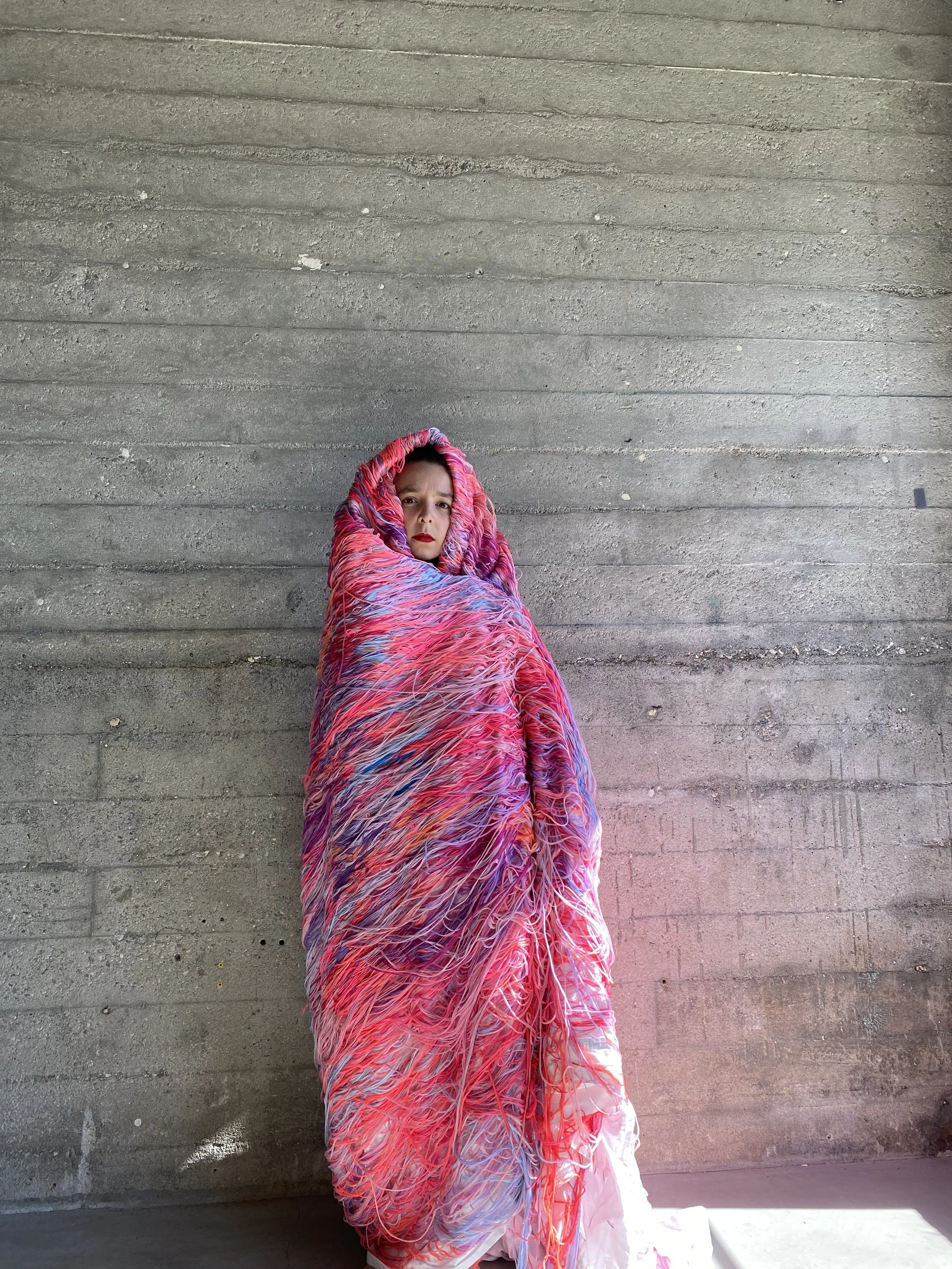
Carmen Mardónez at Helms Design Center (2021)
About myself/ Sobre mí
Carmen Mardónez (Santiago, 1988) is a Chilean textile artist based in Oxford, UK. She studied History and Arts at the Catholic University of Chile and holds a master’s degree in Community Psychology from the University of Chile. Her practice explores themes of rebellion and freedom through oversized freestyle embroidery, fabric sculptures made from textile waste, and immersive textile installations that envelop the viewer in colour and movement. Carmen lived in Los Angeles, California, between 2017 and 2023. There she had her first group show at SoLA Gallery (2019), and was selected by the curator Steven Y. Wong for an award exhibition (2020). Carmen continued her practice supported by numerous grants, scholarships, and artist residencies, participating in curated exhibitions across the United States, Europe, and the UK. In the US, her work has been exhibited in BBAX-Santa Monica, Craft Contemporary, USC Fisher Museum of Art, among others; in Europe, Carmen has exhibited in Verduyn (Belgium), and at Collect and TM Gallery, both in London. Carmen has received the generous support of Quinn Emannuel Trial Lawyers art residency, Philadelphia Magic Gardens’ Julia Zagar residency, among others, and she is currently preparing her first solo museum exhibition at Philadelphia’s Magic Gardens, scheduled to open in spring 2027, generously funded by The Pew Center for Arts & Heritage.